Archive
New issue of WEA Commentaries
WEA Commentaries
Volume 11, Issue 3
Download whole issue
An egalitarian carbon tax: revenue-neutral and dual policy package
Fausto Corvino
WHAT IS ECOLOGY? What Economics Should Have Been
Gregory A Daneke
The Theory of Competition of F.A.Hayek as an Inspirer of the Neoliberal Turn of the 1980s
Arturo Hermann
Don Webber discusses his book, How to enhance your re- search: 100 practical tips for academics
Understanding Macro: The Great Depression (1/3)
from Asad Zaman
Preliminary Remarks: “The trouble is not so much that macroeconomists say things that are inconsistent with the facts. The real trouble is that other economists do not care that the macroeconomists do not care about the facts. An indifferent tolerance of obvious error is even more corrosive to science than committed advocacy of error.” From The Trouble with Macroeconomics (Paul Romer)
Personally, I do not understand why indifference to error is worse than committed advocacy. For an illustration of committed advocacy of error, see postscript below on 70 years of economists’ commitment to a fallacious theory of supply and demand in the labor market. Furthermore, the problem is not confined to macro. Microeconomists are also dogmatically committed to utility maximization, when in fact this hypothesis about consumer behavior is solidly rejected by empirical evidence; see: The Empirical Evidence Against Neoclassical Utility Maximization: A Survey of the Literature
Understanding Macro: The Great Depression
Due to frequent headlines, there is a substantial public awareness of core macroeconomic issues like unemployment, trade agreements, exchange rates, deficit, taxes, interest rates, etc. However, even professionals are often ignorant of the intellectual battles which have shaped modern macroeconomics, since this is not taught in typical PhD programmes in economics. This article attempts to provide the history of ideas which led to the emergence of macroeconomics, since this is an essential background required for informed analysis of these issues.
Lord John Maynard Keynes invented the entire field of macroeconomics in response to the Great Depression in 1929, which could not be understood according to economic theories dominant until then. According to the classical economic theory, forces of supply and demand in the labour market would ensure full employment. Keynes starts his magnum opus, The General Theory of Employment, Interest, and Money, with the observation that the economic theory cannot explain the long, persistent and deep unemployment that was observed following the Great Depression. Keynes set himself the goal of creating a theory which could explain wide fluctuations in levels of employment that he observed. He discovered that creating such a theory involved rejecting deeply held convictions, central to economic theory. read more
Yes, economics has a problem with women
from Julie Nelson
Yes, economics has a problem with women. In the news recently we’ve heard about the study of the Economics Job Market Rumors (EJMR) on-line forum. Student researcher Alice H. Wu found that posts about women were far more likely to contain words about their personal and physical issues (including “hot,” “lesbian,” “cute,” and “raped” ) than posts about men, which tended to focus more on academic and professional topics. As a woman who has been in the profession for over three decades, however, this is hardly news.
Dismissive treat of women, and of issues that impact women more than men, comes not only from the sorts of immature cowards who vent anonymously on EJMR, but even from men who probably don’t think of themselves as sexist. And because going along with professional fashion may be necessary for advancement, women economists also sometimes play along with the dominant view.
Consider a few other cases I’ve noticed during my thirty years in the profession: Read more…
How evidence is treated in macroeconomics
from Lars Syll
“New Keynesian” macroeconomist Simon Wren-Lewis has a post up on his blog, discussing how evidence is treated in modern macroeconomics (emphasis added):
It is hard to get academic macroeconomists trained since the 1980s to address this question, because they have been taught that these models and techniques are fatally flawed because of the Lucas critique and identification problems. But DSGE models as a guide for policy are also fatally flawed because they are too simple. The unique property that DSGE models have is internal consistency. Take a DSGE model, and alter a few equations so that they fit the data much better, and you have what could be called a structural econometric model. It is internally inconsistent, but because it fits the data better it may be a better guide for policy.

Being able to model a credible world, a world that somehow could be considered real or similar to the real world, is not the same as investigating the real world. Read more…
Economics as storytelling: McCloskey again
from Peter Radford
This is not new to most of you of course. You are already steeped in McCloskey’s Rhetoric. Or you ought to be. After all economists are simply telling stories about the economy. Sometimes we are taken in. Sometimes we are not.
Unfortunately McCloskey herself gets a little too caught up in her stories. As in her explanation as to how she can be both a feminist and a free market economist: Read more…
General equilibrium theory — a gross misallocation of intellectual resources and time
from Lars Syll
General equilibrium is fundamental to economics on a more normative level as well. A story about Adam Smith, the invisible hand, and the merits of markets pervades introductory textbooks, classroom teaching, and contemporary political discourse.
The intellectual foundation of this story rests on general equilibrium, not on the latest mathematical excursions. If the foundation of everyone’s favourite economics story is now known to be unsound — and according to some, uninteresting as well — then the profession owes the world a bit of an explanation.
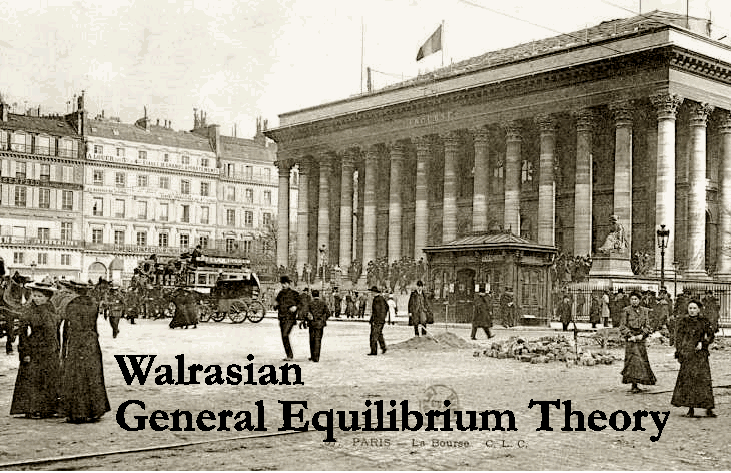
Almost a century and a half after Léon Walras founded general equilibrium theory, economists still have not been able to show that markets lead economies to equilibria.
We do know that — under very restrictive assumptions — equilibria do exist, are unique and are Pareto-efficient.
But after reading Frank Ackerman’s article — or Franklin M. Fisher’s The stability of general equilibrium – what do we know and why is it important? — one has to ask oneself — what good does that do? Read more…
Noah Smith thinks p-values work. Read my lips — they don’t!
from Lars Syll
Noah Smith has a post up trying to defend p-values and traditional statistical significance testing against the increasing attacks launched against it:
Suddenly, everyone is getting really upset about p-values and statistical significance testing. The backlash has reached such a frenzy that some psych journals are starting to ban significance testing. Though there are some well-known problems with p-values and significance testing, this backlash doesn’t pass the smell test. When a technique has been in wide use for decades, it’s certain that LOTS of smart scientists have had a chance to think carefully about it. The fact that we’re only now getting the backlash means that the cause is something other than the inherent uselessness of the methodology.

Hmm …
That doesn’t sound very convincing.
Maybe we should apply yet another smell test … Read more…
Some Issues Re-visited
from Peter Radford
Hmmm.
It seems that some people misunderstood my comments regarding neoclassical economics.
Allow me to reiterate and, perhaps, clarify.
I want to say that I regard neoclassical economics as a triumph. A wonderful achievement. Brilliant.
Please read the fine print: that brilliance has nothing to do with relevance, reality, or any other such yardstick.
All I am saying is that within its own confines, with regard to its own rules, and with respect to the limits placed upon it by its multitude of excellent practitioners, neoclassical economics has been an extraordinary success.
Further, and more to the point, I am saying that the number of instances of economies we find within the space of all possible economies described by neoclassical economics is tiny. So tiny we are unlikely ever to experience one. Read more…
Chicago economics –only for Gods and idiots
from Lars Syll
If I ask myself what I could legitimately assume a person to have rational expectations about, the technical answer would be,
I think, about the realization of a stationary stochastic process, such as the outcome of the toss of a coin or anything that can be modeled as the outcome of a random process that is stationary. I don’t think that the economic implications of the outbreak of World war II were regarded by most people as the realization of a stationary stochastic process. In that case, the concept of rational expectations does not make any sense. Similarly, the major innovations cannot be thought of as the outcome of a random process. In that case the probability calculus does not apply.
‘Modern’ macroeconomic theories are as a rule founded on the assumption of rational expectations — where the world evolves in accordance with fully predetermined models where uncertainty has been reduced to stochastic risk describable by some probabilistic distribution. Read more…
Economics departments — breeding generation after generation of idiot savants
from Lars Syll
Modern economics has become increasingly irrelevant to the understanding of the real world. In his seminal book Economics and Reality (1997) Tony Lawson traced this irrelevance to the failure of economists to match their deductive-axiomatic methods with their subject.
It is — sad to say — as relevant today as it was eighteen years ago.

It is still a fact that within mainstream economics internal validity is everything and external validity nothing. Why anyone should be interested in that kind of theories and models is beyond my imagination. As long as mainstream economists do not come up with any export-licenses for their theories and models to the real world in which we live, they really should not be surprised if people say that this is not science, but autism!
Studying mathematics and logics is interesting and fun. It sharpens the mind. In pure mathematics and logics we do not have to worry about external validity. But economics is not pure mathematics or logics. It’s about society. The real world. Forgetting that, economics is really in dire straits. Read more…
Macroeconomic ad hocery
from Lars Syll
Robert Lucas is well-known for condemning everything that isn’t microfounded rational expectations macroeconomics as “ad hoc” theorizing. 
But instead of rather unsubstantiated recapitulations, it would be refreshing and helpful if the Chicago übereconomist — for a change — endeavoured to clarify just what he means by “ad hoc.”
The standard meaning — OED — of the term is “for this particular purpose.” But in the hands of New Classical–Real Business Cycles–New Keynesians it seems to be used more to convey the view that modeling with realist and relevant assumptions is somehow equivalent to basing models on “specifics” rather than the “fundamentals” of individual intertemporal optimization and rational expectations.
Some Issues
from Peter Radford
First:
I have finally arrived at the point where I can give orthodox simple economics its due. It is a triumph. A system of thought well conceived, brilliantly executed, coherent, consistent, and pretty much complete. Bravo. I love it.
As long as we are trying to examine economies consisting of one or two prescient households, a couple of firms of exquisite accounting excellence, one or two products that are easily substituted for one another, as long as there is no uncertainty, no relevant time, and as long as these various actors can calculate everything at warp speed, we know everything we need to know about economics. The game is over.
As I say: well done everyone.
These unbelievably simple little economies, I assume, must exist somewhere. And wherever they do we can explain them easily.
Where they don’t is another matter.
Orthodox economics is simple economics. Simple.
Second: Read more…
RBC theory — willfully silly obscurantism
from Lars Syll
Lucas and his school … went even further down the equilibrium rabbit hole, notably with real business cycle theory. And here is where the kind of willful obscurantism Romer is after became the norm. I wrote last year about the remarkable failure of RBC theorists ever to offer an intuitive explanation of how their models work, which I at least hinted was willful:
“But the RBC theorists never seem to go there; it’s right into calibration and statistical moments, with never a break for intuition. And because they never do the simple version, they don’t realize (or at any rate don’t admit to themselves) how fundamentally silly the whole thing sounds, how much it’s at odds with lived experience.”
Yours truly, of course, totally agrees with Paul on Lucas’ rabbit hole freshwater school.
And so does Truman F. Bewley: Read more…
The microfoundationalist cyborg dream
from Lars Syll
Are macro-economists doomed to always “fight the last war”? Are they doomed to always be explaining the last problem we had, even as a completely different problem is building on the horizon? Well, maybe. But I think the hope is that microfoundations might prevent this. If you can really figure out some timeless rules that describe the behavior of consumers, firms, financial markets, governments, etc., then you might be able to predict problems before they happen. So far, that dream has not been realized. But maybe the current round of “financial friction macro” will produce something more timeless. I hope so.
So there we have it! This is nothing but the age-old machine dream of neoclassical economics — an epistemologically founded cyborg dream that disregards the fundamental ontological fact that economies and societies are open — not closed — systems. If we are going to be able to show that the mechanisms or causes that we isolate and handle in our models are stable in the sense that they do not change when we “export” them to our “target systems,” they do only hold under ceteris paribus conditions and are a fortiori of limited value for understanding, explaining or predicting real economic systems. Or as the always eminently quotable Keynes wrote in Treatise on Probability(1921): Read more…
On the poverty of microfoundationalist fantasies
from Lars Syll
The microfoundationalist’s fantasy has a powerful hold on macroeconomists. They recognize that an agent-by-agent reconstruction of the economy is not feasible, but they argue that it is something that we could do “in principle,” and that the in-principle claim warrants a particular theoretical strategy. The strategy is to start with the analysis of a single agent and to build up through ever more complex analyses to a whole economy …
The implicit argument in favor of representative-agent models as empirically relevant to aggregate economic data runs something like this: a representative-agent model is not itself an acceptable representation of the whole economy … but it is a first step in a program which step by step will inevitably bring the model closer to the agent-by-agent microeconomic model of the whole economy … I call this argument eschatological justification: it is the claim that there is a plausible in-principle game plan for a reductionist program and that the conclusions of early stages of that program are epistemically warranted by the presumed, but undemonstrated, success of the future implementation of the program in the fullness of time …
What the Export-Import Bank debate tells us about economists
from Dean Baker
In the recent debate on trade policy most reputable economists argued for fast track trade authority and the approval of Trans-Pacific Partnership (TPP), which is likely to be the first trade deal to be covered by the new fast-track rules. Their argument was simple; the reduction of tariffs and other trade barriers will increase efficiency and economic growth. This is the standard argument for free trade.
Given the general view within the economics profession that TPP is good policy, it is striking that so few economists have been outspoken in opposition to the reauthorization of the Export-Import Bank. The reason is that the whole point of the Export-Import Bank is to have the government subsidize selected companies by giving them access to credit at below market interest rates. This is 180 degrees at odds with free trade. It means the government is allocating credit rather than markets. It would be expected to lead to the same type of economic distortions as tariffs and quotas.
The arguments put forward in support of the Ex-Im Bank should have been especially painful to economists since they are exactly the same arguments made in support of protectionist trade measures. For example, proponents of the Ex-Im Bank routinely talked about the number of jobs supported by the bank’s loans, implying that all of these jobs would somehow disappear without subsidized loans from the Ex-Im Bank. Read more…
Why Real Business Cycle models can’t be taken seriously
from Lars Syll
They try to explain business cycles solely as problems of information, such as asymmetries and imperfections in the information agents have. Those assumptions are just as arbitrary as the institutional rigidities and inertia they find objectionable in other theories of business fluctuations … I try to point out how incapable the new equilibrium business cycles models are of explaining the most obvious observed facts of cyclical fluctuations … I don’t think that models so far from realistic description should be taken seriously as a guide to policy … I don’t think that there is a way to write down any model which at one hand respects the possible diversity of agents in taste, circumstances, and so on, and at the other hand also grounds behavior rigorously in utility maximization and which has any substantive content to it.

Real Business Cycle theory basically says that economic cycles are caused by technology-induced changes in productivity. It says that employment goes up or down because people choose to work more when productivity is high and less when it’s low. This is of course nothing but pure nonsense — and how on earth those guys that promoted this theory (Thomas Sargent et consortes) could be awarded The Sveriges Riksbank Prize in Economic Sciences in Memory of Alfred Nobel is really beyond comprehension. Read more…
Death of a Great Australian: Hugh Stretton 1924–2015
from Steve Keen

The great polymath and humanitarian Hugh Stretton died this weekend. I can do no better than to reproduce another great Australian’s tribute to him.
The following is from Geoff Harcourt.
Hugh died last Saturday at the age of 91 after a long illness. I had known him since 1958 when I first came to Adelaide where he was the much-admired Professor of History. In later years we became firm friends, though I continued to regard him with awe and admiration. He was a giant intellect, easily Australia’s most deep and progressive thinker, and a remarkably kind and humane man who lived up to his ideals in many practical ways.
Having established an excellent History department, he resigned from his chair so that he could write. The first product of this new phase was The Political Sciences, published by Routledge in 1969, and named in the Times Literary Supplement as a work of ‘near genius’. It contains a most profound analysis of the inseparability of analysis and ideology in the social sciences. He published privately his ground-breaking book, Ideas for Australian Cities in 1970, which then became a bestseller. Housing and Government, his Boyer Lectures, were published in 1974. His Cambridge University Press book, Capitalism, Socialism and the Environment, (1976), was so far ahead of its time that it has not received the attention it should have. His volumes of essays analyse vital social, political and economic issues in Australian society. His ‘anti-Samuelson’ economics textbook, Economics: A New Introduction (1999), presents to students a viable alternative to mainstream economics.
Most of all, he was a loving and lovable person, always extraordinarily generous and supportive to his many friends and admirers (overlapping sets), and lovingly supportive and proud of his children. He and Pat had many years of deep love and support for one another. I doubt that we shall see his like again.
Geoff Harcourt Professor Emeritus G C Harcourt School of Economics, UNSW Business School
On rational expectations and playing games of whack-a-mole (wonkish)
from Lars Syll
Flash back to 1968 … The standard approach was the temporary equilibrium model that John Hicks developed in Value and Capital. In the temporary equilibrium model, time proceeds in a sequence of weeks. Each week, people meet in a market. They bring goods to market to trade. They also bring money and bonds. The crucial point of temporary equilibrium theory is that the future price is different from our belief of the future price. To complete a model of this kind, we must add an equation to explain how beliefs are determined. I call this equation, the belief function.
Now jump forward to 1972 … Lucas argued that, although we may not know the future exactly: we do know the exact probability distribution of future events. Following the work of John Muth, he called this idea, rational expectations.
Rational expectations is a powerful idea. If expectations are rational, then we do not need to know how people form their beliefs. The belief function that was so important in temporary equilibrium theory can be relegated to the dustbin of history. We don’t care how people form beliefs because whatever mechanism they use, that mechanism must be right on average. Who can argue with that?

The Keynes-Ramsey-Savage debate on probability
from Lars Syll
Neoclassical economics nowadays usually assumes that agents that have to make choices under conditions of uncertainty behave according to Bayesian rules, axiomatized by Ramsey (1931) and Savage (1954) – that is, they maximize expected utility with respect to some subjective probability measure that is continually updated according to Bayes theorem. If not, they are supposed to be irrational, and ultimately – via some “Dutch book” or “money pump”argument – susceptible to being ruined by some clever “bookie”.
 Bayesianism reduces questions of rationality to questions of internal consistency (coherence) of beliefs, but – even granted this questionable reductionism – do rational agents really have to be Bayesian? As I have been arguing elsewhere (e. g. here, here and here) there is no strong warrant for believing so.
In many of the situations that are relevant to economics one could argue that there is simply not enough of adequate and relevant information to ground beliefs of a probabilistic kind, and that in those situations it is not really possible, in any relevant way, to represent an individual’s beliefs in a single probability measure. Read more…



—– look inside —– $5.94 / $20.00

—– look inside —– $4.90 / $8.00

—– look inside —– $15.99
—– look inside —– $5.99 / 12.99

—– look inside —– $5.93 / $12.99

—– look inside —– $4.97 / $9.90

—— Ugarteche, Puyana and Madi ——

Gerson Lima / Maria Alejandra Madi

Edward Fullbrook and Jamie Morgan

————— Michael Hudson ————–

Maria Alejandra Madi / Jack Reardon

————- Edward Fullbrook ————-

—————— Steve Keen —————–

————— Richard Smith —————

————– Gustavo Marques————

– Victor Beker and Beniamino Moro –

————– Lars Pålsson Syll ————-

—————– Stuart Birks —————-
Edward Fullbrook and Jamie Morgan

———— Armando Ochangco ———-

Shimshon Bichler / Jonathan Nitzan

————— Mauro Gallegati ————–

————— Herman Daly —————-

————— Asad Zaman —————

—————– C. T. Kurien —————

————— Robert Locke —————-

 Real-World Economics Review Blog
Recent Comments