Income redistribution in the United States 1913-2011 (2 graphs)
from David Ruccio
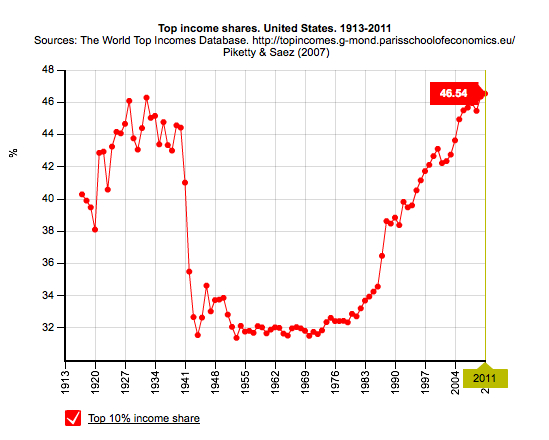
The Great Recession in the United States only depressed top income shares temporarily and, based on data through 2011, will not undo any of the dramatic increase in top income shares that has taken place since the 1970s. Indeed, excluding realized capital gains, the top decile income share in 2011 was equal to 46.5 percent, the highest ever since 1917.
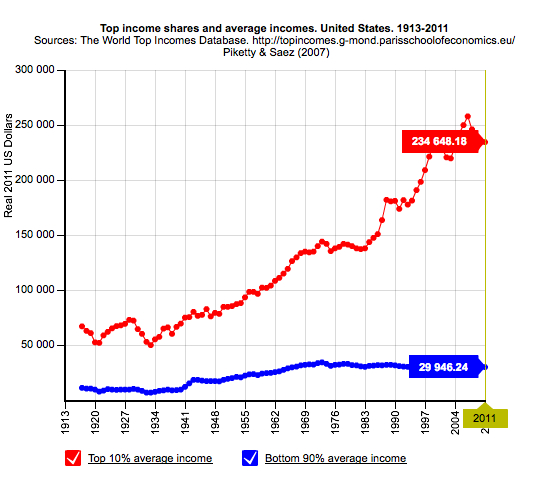
This is what average incomes for the top decile and the rest—the bottom 90 percent—look like over the entire period:
Leave a Reply Cancel reply
Guidelines for Comments
• This blog is renowned for its high level of comment discussion. These guidelines exist to further that reputation.
• Engage with the arguments of the post and of your fellow discussants.
• Try not to flood discussion threads with only your comments.
• Do not post slight variations of the same comment under multiple posts.
• Show your fellow discussants the same courtesy you would if you were sitting around a table with them.
Real World Economics Review
WEA – May 2011 – 11,500+ members
5600 people follow this blog on Twitter
Recent Comments
- davetaylor1 on Graphs of the day – the investment slump in the Eurozone (3 graphs)
- merijnknibbe on Graphs of the day – the investment slump in the Eurozone (3 graphs)
- Si on Graphs of the day – the investment slump in the Eurozone (3 graphs)
- davetaylor1 on Paul Davidson at University of chicago economics department seminar
- wisegrowth on Some links for today
- davetaylor1 on Paul Davidson at University of chicago economics department seminar
- Trond Andresen on Further suggestions for Krugman’s IS-LM reading list
- paul davidson on Paul Davidson at University of chicago economics department seminar
- davetaylor1 on Paul Davidson at University of chicago economics department seminar
- lyonwiss on Paul Davidson at University of chicago economics department seminar
- Allen on Sweden’s 30 years of income redistribution
- Robert Locke on Paul Davidson at University of chicago economics department seminar
- davetaylor1 on Paul Davidson at University of chicago economics department seminar
- Leopold on IS-LM is bad economics no matter what Krugman says
Top Posts and Pages- last 48 hours
- Sweden's 30 years of income redistribution
- "The United States is the only advanced economy in the world that . . ."
- Some links for today
- Further suggestions for Krugman’s IS-LM reading list
- Paul Davidson at University of chicago economics department seminar
- IS-LM is bad economics no matter what Krugman says
- Graphs of the day - the investment slump in the Eurozone (3 graphs)
- Citigroup attempts to disappear its Plutonomy Report #2
- The state of economics: Krugman is wrong
- True Keynesianism - Richard Koo edition
Revere Award in Economics
Dynamite Prize for Economics
Blog Authors
- anmayhew
- Lewis L. Smith
- bruceedmonds
- Kevin P. Gallagher
- deanbaker1
- Steve Keen
- Deniz Kellecioglu
- David F. Ruccio
- donaldgillies
- Peter Dorman
- Editor
- frankackerman
- frankrotering
- Edward Fullbrook
- iettogg
- jamieamorgan
- Jim Stanford
- julieanelson
- Mark Weisbrot
- merijnknibbe
- paul davidson
- Juan Pablo Pardo-Guerra
- Peter Earl
- pesod
- peterradford
- paul ormerod
- Peter Earl
- staveren
Most downloaded RWER papers
- The housing bubble and the financial crisis (Dean Baker)
- The state of China’s economy 2009 (James Angresano)
- Why some countries are poor and some rich: a non-Eurocentric view (Deniz Kellecioglu)
- Trade and inequality: The role of economists (Dean Baker)
- Debunking the theory of the firm—a chronology (Steve Keen and Russell Standish)
- What Is Neoclassical Economics? (Christian Arnsperger and Yanis Varoufakis)
- Global finance in crisis (Jacques Sapir)
- Green capitalism: the god that failed (Richard Smith)
- New thinking on poverty (Paul Shaffer)
RWER Contributors
Editor: Edward Fullbrook. Associate Editor: Jamie Morgan. PAST CONTRIBUTORS: James Galbraith, Frank Ackerman, André Orléan, Hugh Stretton, Jacques Sapir, Edward Fullbrook, Gilles Raveaud, Deirdre McCloskey, Tony Lawson, Geoff Harcourt, Joseph Halevi, Sheila C. Dow, Kurt Jacobsen, The Cambridge 27, Paul Ormerod, Steve Keen, Grazia Ietto-Gillies, Emmanuelle Benicourt, Le Movement Autisme-Economie, Geoffrey Hodgson, Ben Fine, Michael A. Bernstein, Julie A. Nelson, Jeff Gates, Anne Mayhew, Bruce Edmonds, Jason Potts, John Nightingale, Alan Shipman, Peter E. Earl, Marc Lavoie, Jean Gadrey, Peter Söderbaum, Bernard Guerrien, Susan Feiner, Warren J. Samuels, Katalin Martinás, George M. Frankfurter, Elton G. McGoun, Yanis Varoufakis, Alex Millmow, Bruce J. Caldwell, Poul Thøis Madsen, Helge Peukert, Dietmar Lindenberger, Reiner Kümmel, Jane King, Peter Dorman, K.M.P. Williams, Frank Rotering, Ha-Joon Chang, Claude Mouchot, Robert E. Lane, James G. Devine, Richard Wolff, Jamie Morgan, Robert Heilbroner, William Milberg, Stephen T. Ziliak, Steve Fleetwood, Tony Aspromourgos, Yves Gingras, Ingrid Robeyns, Robert Scott Gassler, Grischa Periono, Esther-Mirjam Sent, Ana Maria Bianchi, Steve Cohn, Peter Wynarczyk, Daniel Gay, Asatar Bair, Nathaniel Chamberland, James Bondio, Jared Ferrie, Goutam U. Jois, Charles K. Wilber, Robert Costanza, Saski Sivramkrishna, Jorge Buzaglo, Jim Stanford, Matthew McCartney, Herman E. Daly, Kyle Siler, Kepa M. Ormazabal, Antonio Garrido, Robert Locke, J. E. King, Paul Davidson, Juan Pablo Pardo-Guerra, Kevin Quinn, Trond Andresen, Shaun Hargreaves Heap, Lewis L. Smith, Gautam Mukerjee, Ian Fletcher, Rajni Bakshi, M. Ben-Yami, Deborah Campbell, Irene van Staveren, Neva Goodwin, Thomas Weisskopf, Mehrdad Vahabi, Erik S. Reinert, Jeroen Van Bouwel, Bruce R. McFarling, Pia Malaney, Andrew Spielman, Jeffery Sachs, Julian Edney, Frederic S. Lee, Paul Downward, Andrew Mearman, Dean Baker, Tom Green, David Ellerman, Wolfgang Drechsler, Clay Shirky, Bjørn-Ivar Davidsen, Robert F. Garnett, Jr., François Eymard-Duvernay, Olivier Favereau, Robert Salais, Laurent Thévenot, Mohamed Aslam Haneef, Kurt Rothschild, Jomo K. S., Gustavo Marqués, David F. Ruccio, John Barry, William Kaye-Blake; Michael Ash, Donald Gillies, Kevin P.Gallagher, Lyuba Zarsky, Michel Bauwens, Bruce Cumings, Concetta Balestra, Frank Fagan, Christian Arnsperger, Stanley Alcorn, Ben Solarz, Sanford Jacoby, Kari Polanyi, P. Sainath, Margaret Legum, Juan Carlos Moreno-Brid, Igor Pauno, Ron Morrison, John Schmitt, Ben Zipperer, John B. Davis, Alan Freeman, Andrew Kliman, Philip Ball, Alan Goodacre, Robert McMaster, David A. Bainbridge, Richard Parker, Tim Costello, Brendan Smith, Jeremy Brecher, Peter T. Manicas, Arjo Klamer, Donald MacKenzie, Max Wright, Joseph E. Stiglitz. George Irvin, Frédéric Lordon, James Angresano, Robert Pollin, Heidi Garrett-Peltier, Dani Rodrik, Marcellus Andrews, Riccardo Baldissone, Ted Trainer, Kenneth J. Arrow, Brian Snowdon, Helen Johns, Fanny Coulomb, J. Paul Dunne, Jayati Ghosh, L. A Duhs, Paul Shaffer, Donald W Braben, Roland Fox, Marco Gillies, Joshua C. Hall, Robert A. Lawson, Will Luther, JP Bouchaud, Claude Hillinger, George Soros, David George, Alan Wolfe, Thomas I. Palley, Sean Mallin, Clive Dilnot, Dan Turton, Korkut Ertürk, Gökcer Özgür, Geoff Tily, Jonathan M. Harris, Thomas I. Palley, Jan Kregel, Peter Gowan, David Colander, Hans Foellmer, Armin Haas, Alan Kirman, Katarina Juselius, Brigitte Sloth, Thomas Lux, Luigi Sapaventa, Gunnar Tómasson, Anatole Kaletsky, Robert R Locke, Bill Lucarelli, L. Randall Wray, Mark Weisbrot, Walden Bello, Marvin Brown, Deniz Kellecioglu, Esteban Pérez Caldentey, Matías Vernengo, Thodoris Koutsobinas, David A. Westbrook, Peter Radford, Paul A. David, Richard Smith, Russell Standish, Yeva Nersisyan, Elizabeth Stanton, Jonathan Kirshner, Thomas Wells, Bruce Elmslie, Steve Marglin, Adam Kessler, John Duffield, Mary Mellor, Merijn Knibbe, Michael Hudson, Lars Pålsson Syll, Korkut Erturk, Jane D’Arista, Richard Smith, Ali Kadri, Egmont Kakarot-Handtke, Ozgur Gun, George DeMartino, Robert H. Wade, Silla Sigurgeirsdottir, Victor A. Beker, Pavlina R. Tcherneva, Ali Kadri, Egmont Kakarot-Handtke, Ozgur Gun, George DeMartino, Robert H. Wade, Silla Sigurgeirsdottir, Victor A. Beker, Pavlina R. Tcherneva
RWER Board of Editors
Nicola Acocella (Italy, University of Rome) Robert Costanza (USA, Portland State University) Wolfgang Drechsler ( Estonia, Tallinn University of Technology) Kevin Gallagher (USA, Boston University) Jo Marie Griesgraber (USA, New Rules for Global Finance Coalition) Bernard Guerrien (France, Université Paris 1 Panthéon-Sorbonne) Michael Hudson (USA, University of Missouri at Kansas City) Frederic S. Lee (USA, University of Missouri at Kansas City) Anne Mayhew (USA, University of Tennessee) Gustavo Marqués (Argentina, Universidad de Buenos Aires) Julie A. Nelson (USA, University of Massachusetts, Boston) Paul Ormerod (UK, Volterra Consulting) Richard Parker (USA, Harvard University) Ann Pettifor (UK, Policy Research in Macroeconomics) Alicia Puyana (Mexico, Latin American School of Social Sciences) Jacques Sapir (France, École des hautes études en sciences socials) Peter Söderbaum (Sweden, School of Sustainable Development of Society and Technology) Peter Radford (USA, The Radford Free Press) David Ruccio (USA, Notre Dame University) Immanuel Wallerstein (USA, Yale University)
Family Links
- David Ruccio’s Blog
- Dean Baker Op-Eds and Columns
- Global Development and Environmental Institute
- Mark Weisbrot Op-Eds and Columns
- No Apparent Motive
- Real Climate Economics
- real-world economics review
- Richard Wolff
- Steve Keen’s Debtwatch
- The Progressive Economics Forum
- The Radford Free Press
- Triple Crisis
- Walking Against Australia's Property Mania
Contact
Archives
- May 2013
- April 2013
- March 2013
- February 2013
- January 2013
- December 2012
- November 2012
- October 2012
- September 2012
- August 2012
- July 2012
- June 2012
- May 2012
- April 2012
- March 2012
- February 2012
- January 2012
- December 2011
- November 2011
- October 2011
- September 2011
- August 2011
- July 2011
- June 2011
- May 2011
- April 2011
- March 2011
- February 2011
- January 2011
- December 2010
- November 2010
- October 2010
- September 2010
- August 2010
- July 2010
- June 2010
- May 2010
- April 2010
- March 2010
- February 2010
- January 2010
- December 2009
- November 2009
- October 2009


Nice work. But could you please try the first graph with an added indicator? The Top 1% earners. We shall see that 10% of the 13% gain from like 32% share of all US income to 45% was created by the Top 1% earners. You are involving the top 9% of US population which did not see that much of an increase.
Transition in the financial system coupled with the unipolar world building, after the fall of Berlin wall, could explain the acceleration of the inequality process in the 90s. Need for a welfare state around the world have fallen into peaces as the wall.
So was possibly made the stance of the End of the History and the reign of the happy few and the elites…
Economy has political and strategic motivations. Piloting economy is quite well known along major pieces of work in economics ; problems have arisen from resurgence of class conflicts and the ability to capture resources in a global world.
Mystification of economic rhetoric, thanks to rational expectation (denying uncertainty) was the main strategical tool. Experts and economists were trapped in dishonest propaganda and academic reviews are dishonorably testimonies of the process. We are still waiting for self-criticism in the professional arena before more economic disruptions would be recorded and societies destroyed.
Very interesting data.
One could add another important dimension in income distribution, namely the capital/labor divide. According to one study, labor’s share of income decreased from 75 percent in 1979 to 67 percent in 2007 (http://www.cbo.gov/sites/default/files/cbofiles/attachments/10-25-HouseholdIncome.pdf).
Translating this within the Marxian conceptual framework, one might say that the rate of exploitation has increased from 1/3 to about ½ — that is roughly a 50 per cent increase in exploitation between 1979 and 2007.
(See also: http://www.clevelandfed.org/research/commentary/2012/2012-13.cfm)
Check this out: Top 1% Increase Share of US Income 120%
Using 2007 post-tax dollars, the wealthiest 1% of the US population increased their share of the nation’s income 120% between 1979 and 2007. The top 20% grew their share about 30%, while every other income group decreased their share. Most notably, the bottom 20% lost about 30% of their share of the nation’s income.
Americans Misperceive Wealth Distribution
Read more:http://www.marketingcharts.com/direct/wealthiest-americans-dramatically-increase-income-16296/
Another interesting point:
The Wealth Distribution
In the United States, wealth is highly concentrated in a relatively few hands. As of 2010, the top 1% of households (the upper class) owned 35.4% of all privately held wealth, and the next 19% (the managerial, professional, and small business stratum) had 53.5%, which means that just 20% of the people owned a remarkable 89%, leaving only 11% of the wealth for the bottom 80% (wage and salary workers). In terms of financial wealth (total net worth minus the value of one’s home), the top 1% of households had an even greater share: 42.1%. Table 2 and Figure 1 present further details, drawn from the careful work of economist Edward N. Wolff at New York University (2012).
Read more:http://www2.ucsc.edu/whorulesamerica/power/wealth.html
DO YOU THINK WE ARE DOING SOMETHING WRONG??
Justaluckyfool says, “The Wealth of a Nation is in HOW it redistributes its Wealth”.
pretty clear no one knows what equitable means…….
if the rich want it all….then the “99%”….should live for free…..be housed, fed, clothed, entertained……
Is there a model which can explain this trend? Based on this data, can econometric model predict what would happen in the nearest future?